Deemak Insect — What Is Deemak and What Does It Look Like?
Small, white and almost never seen — the deemak insect does its damage out of sight. Here is what deemak is, exactly what it looks like, how it differs from khatmal and ants, and what to do when you find it.

Most people in Pakistan know the word deemak (دیمک) from the damage it leaves behind — a hollow door frame, crumbling skirting or a cupboard full of eaten files. Far fewer have actually seen the deemak insect itself, because termites spend almost their whole life hidden inside soil, wood and mud tunnels.
This guide shows you exactly what deemak is and how deemak looks, how to tell it apart from khatmal (bed bugs) and flying ants, how a colony works and why it matters for treatment. If you have already found damage, jump to 9 signs of termites in Lahore homes, deemak on walls or deemak in wooden furniture.
What is deemak?
Deemak (also written demak, dimak or deemak) is the Urdu and Punjabi name for termites — small, social insects that feed on cellulose, the main material in wood, paper, cardboard and cotton. Scientifically they belong to the same order as cockroaches (Blattodea), not to ants, even though they are often called "white ants".
In Pakistan the most destructive group is the subterranean termite (for example Heterotermes indicola and Coptotermes heimi), which nests in the soil and travels into buildings through cracks and mud tubes. Fungus-growing termites (Odontotermes) attack gardens and trees, and drywood termites live entirely inside furniture and roof timber.
What does deemak look like? The three castes
A termite colony has different "castes", and each one looks different. This is why people describe deemak in so many ways.
Workers — the ones doing the damage
Workers make up most of the colony. They are blind, soft-bodied and creamy-white, and they look a little like a grain of rice that moves. Workers chew the wood, build the mud tubes and feed the rest of the colony. If you break open a fresh mud tube on a wall and see tiny white insects running, these are workers — and the colony is active.
Soldiers — big heads, big jaws
Soldiers defend the colony. They have the same pale body but a much larger, darker head with pincer-like jaws. When a tube is broken, soldiers rush to the gap. Their head shape is actually how experts identify the termite species.
Flying deemak — the ones you notice
In spring and after monsoon rain in Lahore, mature colonies release thousands of winged termites (alates). They are dark brown, about 1–1.5 cm long including the wings, and fly towards lights in the evening. Soon after landing they drop their wings. Piles of identical, see-through wings on window sills, under tube lights or in balconies are one of the clearest signs that a colony lives nearby.
Deemak vs ants: how to tell the difference
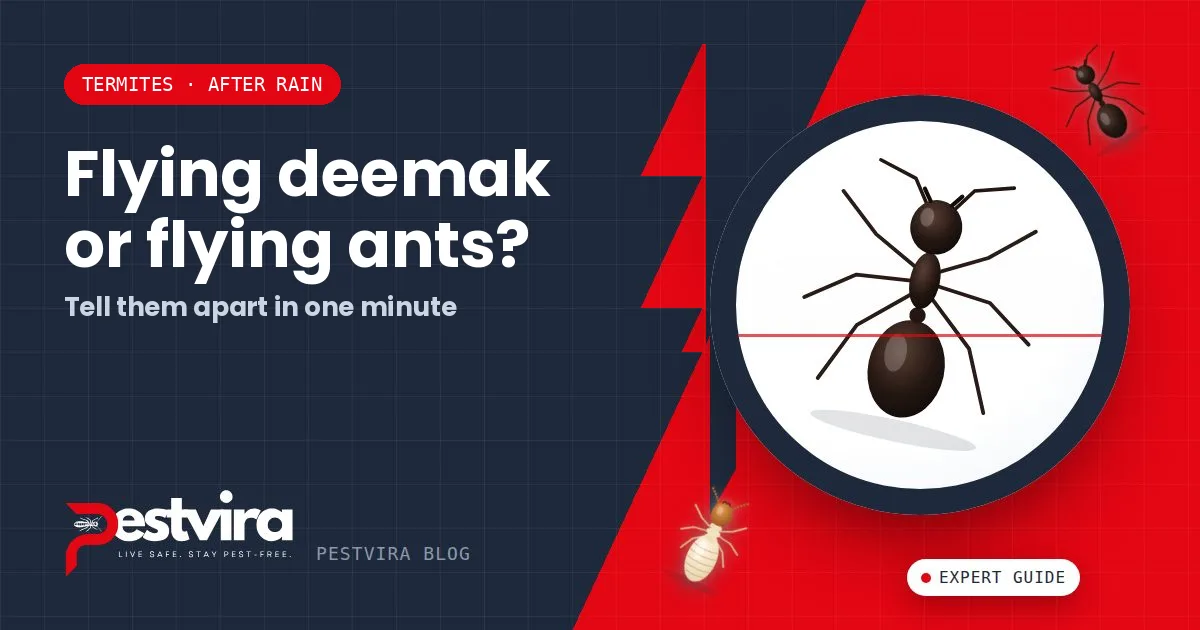
Flying ants and flying termites often appear at the same time of year, but they need completely different treatment. Check these features:
- Waist: deemak has a thick, straight body; ants have a narrow, pinched waist
- Antennae: deemak antennae are straight and bead-like; ant antennae are bent like an elbow
- Wings: deemak has four wings of equal length; ants have bigger front wings than back wings
- Colour: deemak workers are pale cream; most house ants are brown, black or reddish
- Behaviour: deemak hides from light inside tubes; ants walk openly in trails
For a detailed swarmer checklist, read flying deemak vs flying ants. If you are seeing ants marching in the kitchen rather than hidden damage in wood, our guide to ants in Lahore homes and gardens is more useful.
Deemak vs khatmal: not the same insect
People often mix up deemak and khatmal because both hide and both are "small brown or white bugs" — but they are completely different pests:
Read the full side-by-side guide: khatmal and deemak difference. For bed bugs specifically, see khatmal ka ilaj in Lahore.
Where deemak lives in a Lahore home
Subterranean deemak needs moisture and contact with soil, so it usually enters from below:
- Floor–wall junctions and cracks in the ground-floor slab
- Door frames and chaukhats, especially the lower 30 cm
- Skirting, wardrobes and kitchen cabinets fixed to outer walls
- Store rooms with cardboard boxes, old books and files on the floor
- Around water pipes, bathrooms and AC drains where walls stay damp
- Roof timber and wooden ceilings in older houses (often drywood termites)
Lahore's soft alluvial soil, long hot summers and the July–September monsoon make it one of the most termite-prone cities in Punjab. New houses in DHA, Bahria Town and other societies are at risk if they were built without pre-construction termite proofing.
Is deemak harmful to humans?
Deemak does not bite people, sting or spread disease. The harm is financial and structural: termites can hollow out door frames, wooden floors, furniture, books and documents, and the damage is usually found late because they work from the inside. Damp conditions that termites love can also encourage mould.
How to get rid of deemak
Spraying the termites you can see — with kerosene, phenyl or a store-bought spray — kills a few workers but leaves the colony underground untouched, so the damage moves elsewhere. Lasting control has to reach the colony or cut it off from the building.
- 1InspectTrace every mud tube, damaged area and moisture source
- 2IdentifySubterranean or drywood — the type decides the method
- 3BarrierDrill-fill-seal: inject long-lasting termiticide into the soil along walls and floors
- 4Wood treatmentInject affected furniture or frames for drywood termites
- 5MonitorFollow-up visits and bait stations where needed
PestVira uses non-repellent termiticides that termites cannot detect, so workers pass through the treated soil and carry the product back to the colony. See the full process on our deemak (termite) control in Lahore page, or book a free termite inspection.